
The Home That Pays You Back: Understanding the True Cost of High-Performance Design
When clients first sit down with us, the conversation often turns to upfront cost. What they don’t always expect is that a well-designed high-performance home is not just an environmental choice. It is a financial strategy.
The building industry has long operated on a cost-first mentality: minimize what you spend today, worry about everything else later. For decades, that approach seemed rational. Energy was cheap, financing was plentiful, and the future felt comfortably abstract. But that calculus has shifted in fundamental ways, and homeowners who understand the new math are building something most houses can never offer: genuine cost predictability over the life of the home.
WHAT DOES “COST PREDICTABILITY” REALLY MEAN?
A conventional home is, financially speaking, a variable-rate instrument. Your utility bills fluctuate with the season, with fuel markets, and with the slow deterioration of building systems that were never designed to last. You budget for an average spend and then you absorb the variance. In a cold New England winter or a blistering summer, that variance can be significant.
A high-performance home changes that relationship. When a building envelope is truly airtight and well-insulated, when windows are triple-glazed and thermally broken, when mechanical systems are right-sized and efficient, the home's energy demand becomes small and stable. A small, stable load is a predictable load. And a predictable load is something you can plan around, especially when paired with on-site solar generation.
"We tell our clients: you are not spending more on a high-performance home. You are pre-paying a portion of the energy bills you would have paid anyway, at today's prices, in exchange for certainty."
WHERE THE SAVINGS ACTUALLY LIVE
It helps to think about long-term savings in three distinct layers, each operating on a different timeline.
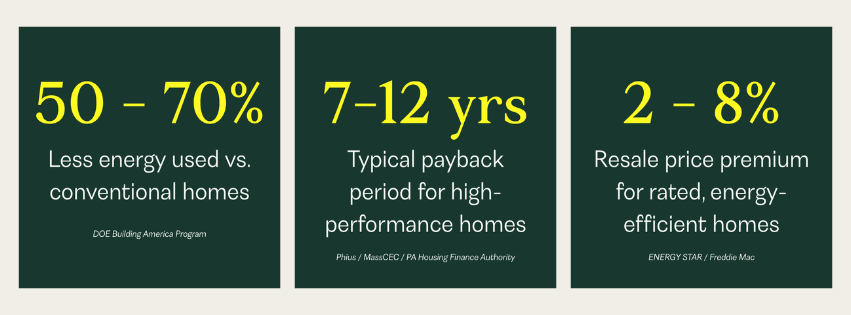
The first layer is operational savings, which begin on day one. Heating, cooling, water heating, and lighting account for the vast majority of a home's energy spend. According to the DOE's Building America Program, net-zero-energy homes consume 50% to 70% less energy than conventional homes of the same size. For a family spending $3,500 per year on energy today, that is a real savings of $1,750 to $2,450 annually. Over 30 years, at conservative energy price escalation rates, that number compounds into something genuinely substantial. It is important to note that electricity costs overall are more stable than fossil fuels, which can be quite volatile. While the cost of electricity may fluctuate, the energy usage in a high-performance home is much more predictable than that of a conventional home. For true operational savings, right-sized solar installation will make the home truly net-zero, meaning the home generates as much renewable energy as it consumes over the course of a year (DOE).
The second layer is maintenance and equipment lifecycle savings. This is the one homeowners most often overlook. Oversized mechanical systems in leaky, poorly insulated homes cycle on and off constantly, wearing out faster and requiring replacement on shortened schedules. In a tight, well-insulated envelope, a smaller, right-sized system runs smoothly and consistently. That kind of sustained energy reduction adds up quickly. Industry research consistently places the payback period for high-performance upgrades in the 7 to 12 year range, a figure supported by data from Phius, MassCEC, and the Pennsylvania Housing Finance Authority, with the timeline shaped by local energy prices and the specifics of each project.
The third layer is resilience value. This is harder to quantify but real. During grid disruptions, net-zero homes with solar and battery backup systems are better able to maintain comfortable indoor temperatures without any utility power. The homes that perform best had one thing in common: a well-insulated envelope that holds temperature for hours on end, dramatically reducing the load on backup systems. Resilience has a monetary value, even if it does not appear on a utility bill.
THE APPRAISAL PROBLEM AND HOW IT’S CHANGING
One honest challenge in the high-performance market has been the difficulty of capturing energy value in appraisals. For years, a beautifully detailed, airtight, solar-powered home appraised at essentially the same value as a conventional house next door. That gap is closing. ENERGY STAR data shows resale price premiums ranging from 2% to 8% in most markets for rated, energy-efficient homes, and a Freddie Mac white paper found that energy-rated homes sold for nearly 3% more on average than comparable unrated homes. Third-party appraiser studies of Pearl Certified homes put the premium even higher, at around 5.5%. In short, the market is beginning to price what thoughtful buyers have always known.
A NOTE ON INCENTIVES
The federal landscape shifted significantly at the end of 2025. The Inflation Reduction Act's two main residential credits — the Energy Efficient Home Improvement Credit (25C) and the Residential Clean Energy Credit (25D), which covered solar, heat pumps, insulation, and windows at up to 30% of cost — both expired on December 31, 2025 under the One Big Beautiful Bill Act (congress.gov).
For our clients in Rhode Island, Massachusetts, and Maine, however, robust state-level programs remain active and, in some cases, have grown more generous to fill the gap:
Rhode Island - Clean Heat RI
Covers 60% of heat pump system and installation costs, up to $11,500 (greenenergyconsumers). Income-eligible households may qualify for up to $18,000 or full coverage. Funded through ARPA with a deadline of December 31, 2026, or until funds run out (nuwattenergy).
Massachusetts - Mass Save
Offers 75%–100% off approved insulation and air sealing improvements, rebates up to $10,000 on qualifying heat pump systems, and 0% HEAT Loan financing up to $25,000 for energy efficiency upgrades (Mass Save).
Maine - Efficiency Maine
Heat pump rebates of $1,000–$3,000 per unit (up to 3 units) based on income tier, plus a $500 whole-home bonus through December 2026. Weatherization rebates up to $8,000 for low-income households. 0% Green Bank loans up to $15,000 available for all income levels (Efficiency Maine).
Program terms and funding availability change. We always recommend consulting a tax professional early in your project to confirm which incentives apply to your specific situation.
HOW WE THINK ABOUT THIS WITH CLIENTS
High-performance design is not a single feature or upgrade. It is a set of interrelated decisions, each reinforcing the others, that together produce a home that simply behaves differently from a conventionally built one. Understanding those decisions is the clearest path to understanding where the financial resilience comes from.
As we mentioned above, the building envelope comes first. A continuous air barrier, thick well-installed insulation, and thermally broken triple-glazed windows work together to dramatically reduce the energy a home needs in the first place. A smaller demand is a more stable demand, and a more stable demand is the foundation of everything else: right-sized mechanical systems, smaller solar arrays, lower operating costs across the full life of the home.
Moisture management is just as critical, and often under appreciated. Water damage is by far the largest maintenance cost driver in conventional construction, and high-performance detailing dramatically reduces that risk. Proper vapor control, thoughtful flashing, and airtight assemblies protect the structure itself, not just its energy systems. A home that stays dry stays sound, and a home that stays sound holds its value.
Mechanical systems in a high-performance home are right-sized by design. Because the envelope does so much of the work, the heating and cooling equipment runs at a gentler, more consistent pace, rather than the short aggressive cycles that wear out conventional systems prematurely. Paired with heat recovery ventilation, these systems also maintain superior indoor air quality year-round, another dimension of value that rarely appears in a utility bill comparison but matters deeply to the people living inside.
The homes we design are built to last 100 years. The decisions made in design and construction compound over that entire period. Getting them right is not just an environmental responsibility. It is the most rational financial decision most families will ever make.
